How to Choose the Right 20ft Storage Container

Choosing the right 20ft storage container starts with what must fit, where it will sit, and how often you need access. A container may look spacious from the outside. Interior measurements tell a less comfortable story. UNCTAD’s Review of Maritime Transport 2024 reports that ships carry over 80% of global merchandise trade by volume, underscoring how central containers are to modern logistics. But a shipping statistic cannot tell you whether your shelving, equipment, or boxes will fit your site.

Hapag-Lloyd’s published specifications for a standard 20-foot dry container give approximate interior dimensions of 5.9 metres long, 2.35 metres wide, and 2.39 metres high, with about 33 cubic metres of capacity. Actual dimensions can vary by unit and manufacturer, so check the specific container before arranging delivery. Numbers help. They do not decide. Measure your largest item, allow room for doors and walkways, and consider whether pallets must be moved in or out. Check the ground for level support, and confirm that a delivery vehicle can reach the placement area. Access matters. So does condition: inspect the floor, doors, seals, and visible signs of corrosion before purchase or rental. I would not choose by price alone; a low-cost unit can become frustrating when a door sticks or the usable width falls short. The right choice balances dimensions, condition, access, and intended use.
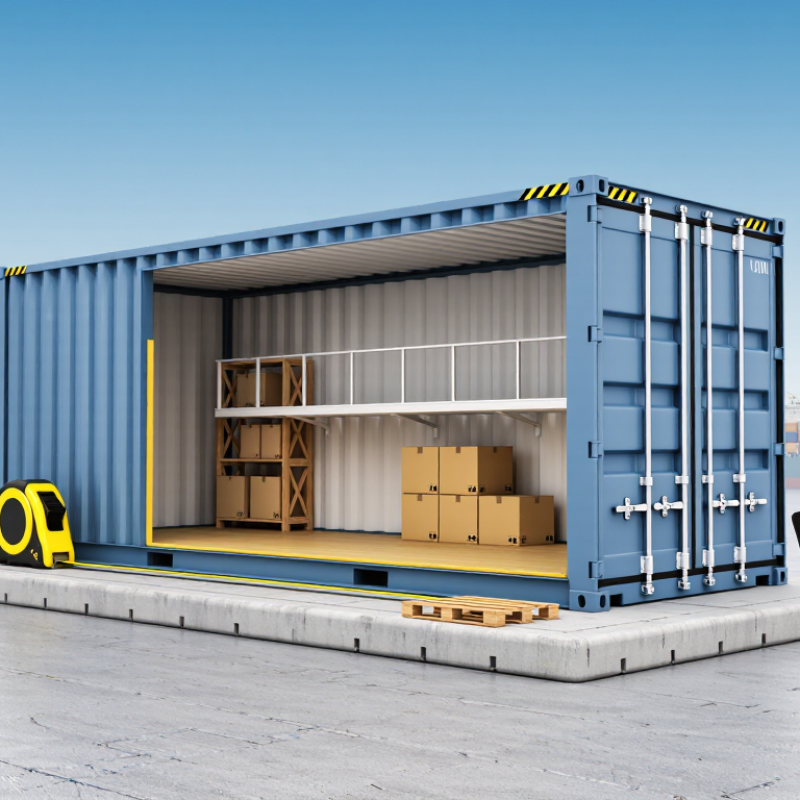
How to Choose the Right 20ft Storage Container

Measure the Site: ISO 668 20ft Containers Are 6.058 × 2.438 m Externally

How to Choose the Right 20ft Storage Container

Measure the site before arranging delivery. ISO 668:2020 gives a standard 20ft container external length of 6.058 m and width of 2.438 m. Those figures describe the container, not the space needed to position it. Allow extra room for the delivery vehicle, lifting equipment, and safe access around the doors. Check overhead clearance too; a standard-height unit is about 2.591 m tall externally. Uneven ground can complicate placement. A small slope matters.

Tip: Measure the narrowest entrance, not just the open area. Include gates, roof edges, pipes, and parked vehicles in your checks. Ask the delivery operator what access and turning space their equipment needs, since vehicle dimensions and lifting methods vary. Keep the route firm and clear; soft ground may not support a loaded vehicle. Take photos from the entrance to the intended position. They can reveal obstacles a tape measure misses.

Compare your measurements with the container’s specification sheet, and confirm whether listed dimensions are external or internal. ISO dimensions are a reliable starting point, but they do not guarantee that a particular delivery setup will fit your property. I would remeasure before booking, even if the site looks spacious. It is an easy step to overlook, and a tight turn can become an expensive delay.

Estimate Volume: A Standard 20ft Dry Container Holds About 33.2 m³

A standard 20ft dry container holds about 33.2 m³ of cargo by its nominal internal volume. That figure is a useful starting point, not a promise that every load will fit. Internal measurements can vary slightly, and door openings may be narrower than the container’s full interior. Check the actual specifications before planning a close fit. Small details matter.

Estimate your goods’ volume by multiplying each item’s length, width, and height, then adding the results. For example, a box measuring 0.6 × 0.4 × 0.5 metres occupies 0.12 m³. But a pile of boxes rarely uses every cubic metre efficiently. Gaps, irregular shapes, and access needs reduce usable space. Leave room for careful loading rather than aiming for exactly 33.2 m³. Also check weight limits separately; volume alone cannot tell you whether a container can safely carry the load. The estimate will still be imperfect. That is worth remembering.

Check Payload: Verify the CSC Plate; Ratings Vary by Container

How to Choose the Right 20ft Storage Container

A 20ft container can look spacious and still fall short on payload. Check the CSC plate before comparing prices or arranging delivery. It records key weight limits, including maximum gross mass and tare mass. Subtract tare from maximum gross mass to estimate the container’s rated payload. A simple calculation, but easy to overlook.

Ratings vary between containers, even when their external dimensions match. Read the plate on the specific unit you plan to buy or rent; don’t rely on a listing for a different container. Check that the figures are legible, and confirm the units. Small detail. Big difference. If the plate is missing or unreadable, ask the supplier for documentation tied to that unit.

Treat the calculated payload as a limit, not a target. Your cargo’s weight, how it is distributed, and the condition of the floor can all affect safe use. For example, several heavy items placed in one corner may create a problem even when their total weight seems acceptable. Check loading and handling equipment limits too. I’d also leave a margin rather than plan right up to the rating; it can feel overly cautious, but weight estimates are not always exact.

Select the Type: Compare Dry, High-Cube, Refrigerated, and Open-Top Units

A dry 20-foot container suits furniture, tools, and boxed goods that need basic weather protection. It is the straightforward option, but check the interior measurements and door opening before buying or renting. A tall wardrobe may fit inside yet still be difficult to angle through the doors. High-cube units add roughly a foot of height, useful for bulky cargo or stacked equipment. That extra space can be easy to underestimate.

Refrigerated units are designed for temperature-sensitive goods, but they need a reliable power supply and regular temperature checks. Their insulated walls reduce usable interior space, so compare the actual dimensions with your load. Open-top units allow loading from above with suitable lifting equipment. They can help with tall or awkward items, though the cover and cargo restraints need careful attention. Weather exposure remains a concern during loading.

Tips: Measure your largest item, including handles and packaging. Check floor condition, door clearance, and delivery access. Ask about power requirements for refrigerated units. I have seen people focus on container length and overlook turning space at the site; that small detail can cause a frustrating delay. If the cargo is unusual, confirm the fit before committing.

How to Choose the Right 20ft Storage Container

Compare typical interior height to help choose between dry, high-cube, refrigerated, and open-top units.

High-cube units typically provide the greatest vertical clearance. Refrigerated units have insulated walls and refrigeration equipment that reduce usable interior space; open-top units have no fixed roof, so the figure represents approximate sidewall height. Dimensions vary by model and manufacturer—confirm the unit’s specifications and usable dimensions before purchase or loading.

Plan Delivery Access: Allow for the Container’s 2.438 m External Width

A standard 20-foot storage container is about 2.438 metres wide externally. ISO 668 specifies this width for standard freight containers, but the container is only part of the delivery footprint. Measure the narrowest point along the route, including gateposts, wall corners, parked cars, and low branches. A tape measure helps. So does a slow walk-through.

Allow extra room; the exact amount depends on the delivery truck and unloading method. The Federal Highway Administration’s Federal Size Regulations list 102 inches (2.591 metres) as the general width limit for many commercial vehicles on designated highways. That figure is not a safe gate-width recommendation: mirrors, vehicle configuration, and turning movement still matter. Ask the delivery operator for the truck’s width and required approach space. Check for overhead obstructions and room to turn before booking. I would not rely on a single measurement, especially where a driveway narrows near the entrance. The container may fit on paper, yet the truck may not. ISO 668 and FHWA guidance provide useful dimensions, not a substitute for checking the actual site.

How to Choose the Right 20ft Storage Container — Plan Delivery Access: Allow for the Container’s 2.438 m External Width
Planning item Dimension or calculation Access planning guidance Important note
Standard 20ft container external width 2.438 m (8 ft) Measure the narrowest part of the route, including gates, posts, walls, and projecting roof edges. This is the container’s external width; it does not include any additional delivery or positioning clearance.
Route width with 150 mm clearance per side 2.738 m minimum planning width Calculated as 2.438 m + 0.150 m + 0.150 m. Treat this as a tight straight-through allowance, not a guarantee of successful delivery. The required clearance depends on the delivery vehicle, visibility, surface conditions, and the driver’s positioning method.
Route width with 300 mm clearance per side 3.038 m planning width Calculated as 2.438 m + 0.300 m + 0.300 m. A wider route gives more room for alignment and reduces the risk of contact. This is a practical planning allowance, not a standard container or vehicle specification.
Standard 20ft container external length Approximately 6.058 m Check the set-down area length and leave room for the delivery method to position the container. Confirm the exact container dimensions and unloading requirements with the supplier before delivery.
Standard-height container external height Approximately 2.591 m Check overhead clearance along the entire route, including branches, cables, arches, and sloping entrances. The container may be carried or lifted differently depending on the vehicle and delivery method; ask for the required vehicle clearance.
High-cube container external height Approximately 2.896 m If selecting a high-cube model, recheck overhead restrictions rather than relying on standard-height measurements. High-cube models are taller than standard-height containers; available sizes and exact dimensions can vary.
Turns and angled approaches No single fixed width Allow more room than the straight-route width and assess corners, turning space, slope, and the container’s full swept path. A route that is wider than 2.438 m may still be unsuitable if the vehicle cannot turn or align safely.
Final set-down position Confirm site-specific space Check that the container can be placed level, with its doors facing the intended access area and enough room to open them. Ground strength, overhead obstructions, drainage, and local access restrictions should also be checked before delivery.